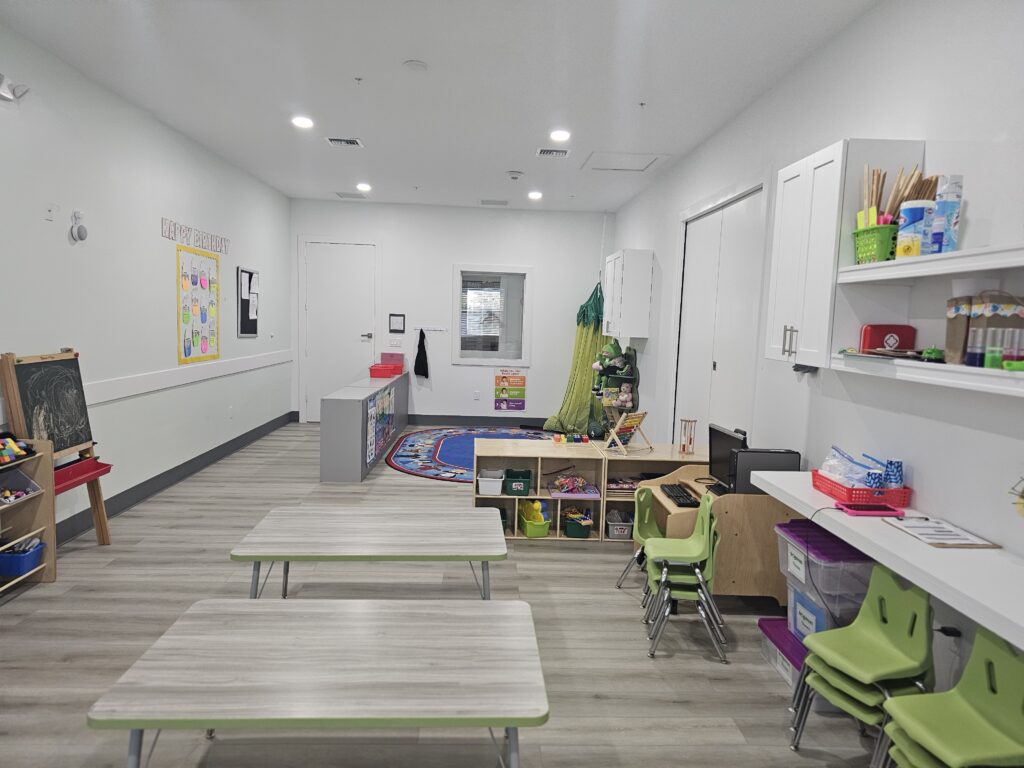
Play-based rooms teach through toys, blocks, puzzles and art, while worksheet rooms rely on seat work and paper tasks. A tour shows you which one you are in. Watch what the children are doing, how long they sit and who is leading the activity. Those details tell you more than a brochure.
What does play-based learning look like?
In a play-based room, children learn by doing. You will see them building with blocks, working puzzles, playing games and making art. Teachers move around the room, ask questions and add new ideas while the children play.
The three-year-old program at My First Place Academy is built around play-based learning with toys, games, blocks, puzzles and art. It is a structured learning environment, so play is not random. Each activity has a purpose, and the day has a rhythm that children can follow.
Look for these signs in a play-based classroom.
- Children moving between centers, such as blocks, art and books.
- Teachers sitting at child level, talking and asking questions.
- Materials a child can reach and choose, not only what the teacher hands out.
- Short group times that mix songs, stories and movement.
- Art on the walls that looks different from child to child.
What do worksheet-style rooms look like?
A worksheet-style room has children seated at tables, working on paper tasks such as tracing letters or filling in pages. The teacher leads from the front, and the day is built around finishing the task at hand.
Some families like that structure. Others find it asks a lot of a young child who is still learning to sit for a while. Neither style is wrong for every child, but they feel very different once you step into the room.
Signs of a worksheet-heavy room include rows of seats, pencils and printed pages at most tables, and long stretches where children are expected to stay quiet and still. Ask how much of the day looks like that.
What can you see during a tour?
On a tour, you can see how children spend their time, how teachers speak to them and how the room is set up. Those three things show the style of a classroom faster than any description.
- Stand in the doorway for a minute and watch before anyone talks to you.
- Count how many children are doing the same task and how many are choosing their own.
- Listen to the room. Talking, laughing and busy sounds are different from a silent room.
- Look at the shelves. Are toys, blocks and art supplies open and in reach?
- Watch a transition, such as cleanup time or snack, and see how the teacher guides it.
My First Place Academy welcomes parents to tour, and the open-door policy invites visits. You can see the classrooms for yourself and watch the children at work. The academy is a bilingual English-Spanish daycare and preschool in Port St. Lucie, with bilingual immersion in every classroom, so you will hear both languages during the day.
Which questions help you compare them?
Ask questions that get the teacher to describe a normal day. The answers show how much time goes to play, how much to group work and how much to paper tasks.
- What does a typical morning look like, hour by hour?
- How do children choose what to do, and who decides?
- When do children use paper and pencils, and for how long?
- How do teachers handle a child who needs to move or lose focus?
- How does the room support children who speak more than one language?
- How will I hear about my child's day?
Write the answers down for each school you visit. A short list makes it easier to compare once the tours are done. You can also read our guide to choosing a daycare in Port St. Lucie for more to look for. Details on each age group are on the programs page.
How does language fit into a play-based day?
Play gives children a natural reason to talk. When they build a tower together or set up a pretend store, they use words to ask, share and take turns. In a bilingual room, those words come in two languages.
My First Place Academy uses complete bilingual immersion in every classroom, from infant through VPK, and sign language with infants and toddlers. Ask any school you tour how language shows up in the daily routine, not only in a lesson. A child hears more from a teacher who talks while they play than from a page they have to complete.
It also helps to ask who speaks to the children during play and in which language. Listen for it on your visit. You will learn a lot from the way teachers talk during snack, cleanup and the walk to the playground.
Does your child's temperament matter?
Yes. A child who is active, curious or shy may do better in a room that lets them move and choose. A child who likes quiet and order may enjoy more structure. Your own child's habits at home are the best clue.
Think about how your child plays at home. Do they build, pretend or take things apart? Do they prefer to sit with a book? Do they warm up slowly in a new place? Share this with the teacher on your tour and listen to how they would adjust the day.
No classroom can promise a particular result for any child, and this post does not. What a good room can do is match a child's pace and keep learning warm and engaging. When you tour, picture your child there and notice how you feel.
To see a classroom in person, call My First Place Academy at (772) 446-4011 and arrange a tour. The center is open Monday to Friday, 6:30am to 6:00pm, and serves families across Port St. Lucie, St. Lucie West, Tradition and nearby areas.
Frequently Asked Questions
Can a preschool use both play and worksheets?
Yes. Many rooms mix them. The question is how much of the day goes to each. On a tour, ask what a normal morning looks like and watch what the children are doing.
Is play-based learning just free time?
No. In a structured play-based room, the teacher sets up the activities, guides the children and adds new ideas as they play. The play has a purpose and the day follows a pattern.
When should I schedule a preschool tour?
Pick a time when children are active, such as mid-morning, so you can see the room at work. Call ahead and ask which times show a typical day.
What if my child is shy on a tour?
That is normal. Bring your child along if the school allows it, and watch how the teacher greets them. A warm, patient response tells you a lot about the room.
Tour a play-based classroom
Call My First Place Academy or schedule a tour and see the classrooms in use.